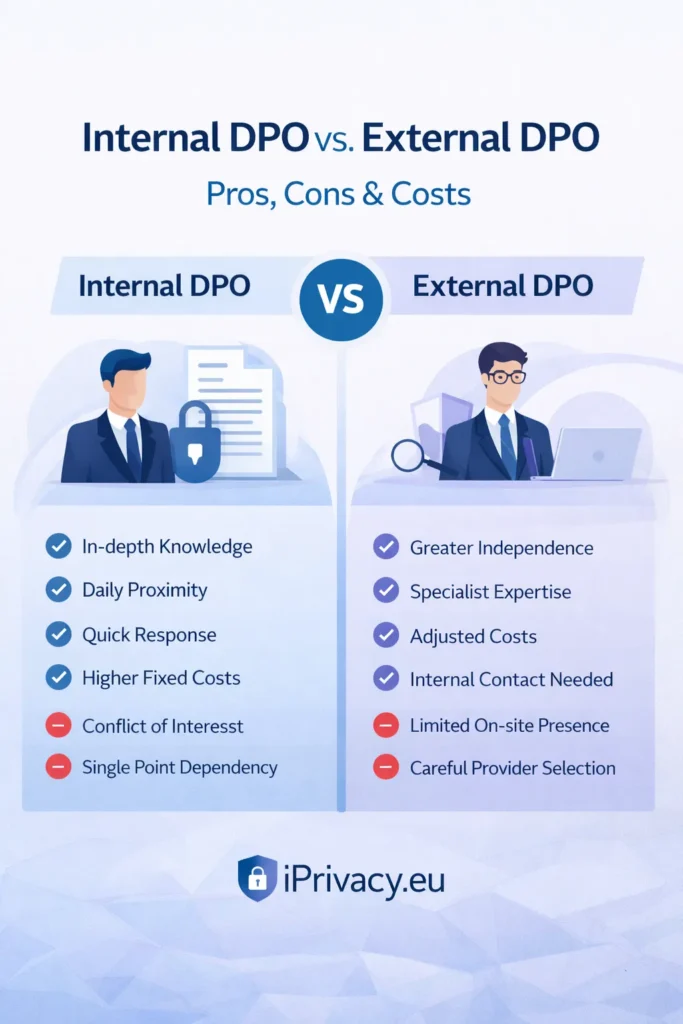
Internal DPO vs External DPO, which is best for you?
The appointment of a Data Protection Officer (DPO) continues to raise questions for many SMEs. The issue is rarely purely legal. In practice, the decision usually involves organisational structure, internal maturity, available budget, regulatory risk and implementation capacity.
For many companies, the question is simple to ask but difficult to answer: does it make more sense to have an internal DPO or to hire an external DPO?
The answer depends on several factors. Not all organisations are required to appoint a DPO. And even where this obligation exists, the model chosen has a direct impact on the independence of the role, the quality of monitoring, costs and the ability to maintain compliance over time.
In this practical guide, we explain the differences between internal DPOs and external DPOs, analyse the pros, cons and costs, show in which situations each model makes more sense and provide a final checklist to help with the decision.
What is a DPO and what is their role?
The DPO is the person responsible for monitoring, supervising and supporting the organisation in complying with data protection rules, in particular the GDPR. They do not replace management, nor do they “take the blame” in the event of non-compliance. Responsibility remains with the organisation. The DPO acts as a specialised, independent and permanent monitoring function.
Among their most typical responsibilities are:
- informing and advising the organisation on data protection obligations;
- monitoring compliance with the GDPR and internal policies;
- overseeing data protection impact assessments;
- cooperating with the supervisory authority;
- acting as a point of contact for data subjects and regulators;
- promoting an internal culture of privacy, training and best practice.
In practice, a good DPO helps transform data protection from an abstract obligation into a concrete operational role.
Do all companies need a DPO?
No. Not all companies are required to appoint a DPO. The obligation depends, among other factors, on the nature of the business, the type of data processed and the scale of the processing.
Put simply, appointment is usually required when:
- the organisation is a public authority or body;
- the core activities involve regular and systematic monitoring of data subjects on a large scale;
- the core activities involve large-scale processing of special categories of data or data relating to criminal convictions and offences.
Even where appointment is not mandatory, many SMEs choose to have support equivalent to the role of a DPO, particularly when:
- they process sensitive data;
- they rely heavily on digital marketing and analytics;
- they work with multiple processors;
- they operate in regulated sectors;
- they need to demonstrate governance and accountability to clients, partners or international groups.
This is precisely where the services of iPrivacy.eu can be particularly relevant, whether through support in the form of an external DPO or through services for the implementation and ongoing monitoring of the GDPR, privacy governance, policies, records, audits and incident response.
What is an internal DPO?
An internal DPO is an employee of the organisation itself appointed to perform this role. This may be someone hired specifically for the role or an existing professional within the company who takes on this responsibility, either fully or in part.
At first glance, the in-house model seems natural: the person knows the company, its processes, teams, systems and organisational culture. This proximity can facilitate day-to-day monitoring and internal awareness-raising.
However, the in-house model also presents significant challenges, particularly regarding independence, conflicts of interest and the need for ongoing training.
Advantages of an internal DPO
1. In-depth knowledge of the organisation
An in-house DPO has a better understanding of the actual business context. They understand the company’s structure, decision-making flows, the systems used and operational risks. This can speed up the diagnosis of problems and the implementation of corrective measures.
2. Closer proximity to teams
Daily presence allows for closer relationships to be built with departments such as HR, marketing, IT, operations and senior management. This proximity can improve the adoption of procedures and facilitate responses to internal queries.
3. Immediate availability
In organisations with a high volume of operations, frequent incidents, numerous projects or multiple business units, having an in-house DPO can mean a faster response and more consistent monitoring.
4. Integration with internal governance
When well-structured, the in-house DPO can more easily participate in committees, decision-making meetings, procurement processes, digital projects and internal transformation initiatives from the outset.
Disadvantages of an in-house DPO
1. Risk of conflict of interest
This is one of the biggest problems. The DPO cannot hold roles that determine the purposes and means of processing. Therefore, it is not always appropriate to appoint heads of IT, HR, marketing, operational compliance, security or executive management to the role.
In SMEs, where resources are limited and staff often juggle multiple responsibilities, this risk is particularly common.
2. Higher fixed costs
An in-house DPO typically entails ongoing costs: salary, social security contributions, training, tools, management time, cover during holidays or absences, and any additional legal or technical support.
Even when the person is already on the staff, there is a real cost associated with their assignment and specialisation.
3. Difficulty in keeping up to date with technical and legal developments
Data protection is a dynamic field. It requires constant updating on regulatory guidelines, decisions, case law, international transfers, cookies, impact assessments, incident management and new technologies.
Not all SMEs have the scale to justify intensive ongoing training for a dedicated internal resource.
4. Reliance on a single person
If the in-house DPO leaves the company, changes roles or becomes unavailable, the organisation may be left without operational continuity in the role. This creates vulnerability, especially where there is no robust documentation or support team.
What is an external DPO?
An external DPO is a specialist professional or entity contracted to perform the role of DPO for the organisation. Rather than being a permanent member of staff, they operate under a service provision contract, maintaining functional independence and technical focus.
This model is increasingly common among SMEs, corporate groups and organisations seeking to combine specialisation, controlled costs and regular monitoring.
At iPrivacy.eu, this model falls under our DPO as a Service / External DPO services, designed for organisations requiring specialised, independent and scalable support in complying with the GDPR and structuring their privacy governance.
Advantages of an external DPO
1. Greater independence
Independence is a core requirement of the role. An external DPO tends to be less exposed to internal pressures, hierarchical conflicts or operational interests. This reinforces the credibility of the role and the quality of the advice provided.
2. Access to multidisciplinary expertise
When the role is provided by a specialist firm, the organisation often benefits from combined expertise in areas such as the GDPR, information security, governance, incident response, contracts with processors, impact assessments and training.
This is particularly important in more complex areas, such as international data transfers, legal bases, risk management, data retention, privacy by design and responding to data subjects’ requests.
3. More predictable and tailored costs
For many SMEs, the external model is financially more efficient. Instead of bearing the full cost of a full-time specialist resource, the company pays for a service tailored to its size, risk profile and actual needs.
4. Service continuity
By engaging a specialist entity, the company reduces the risk of dependence on a single individual. Even if there is a change in the service provider’s team, the role can maintain continuity, methodology, history and documentation.
5. Faster implementation
Many organisations need more than just ‘a name’ to comply formally. They need to put records, policies, contracts, procedures, training and governance in order. An experienced external DPO can generally accelerate this process.
Disadvantages of an external DPO
1. Less day-to-day physical presence
An external DPO may not be present at the organisation every day. If the service is not well designed, this can create a sense of distance or reduced integration with internal teams.
2. Need for a good internal point of contact
Even with an external DPO, the company needs internal contacts. Without the involvement of management, IT, HR and operational departments, the service loses its effectiveness.
3. Risk of choosing the wrong provider
Not all external DPO services are of the same quality. Some offerings are limited to reactive or overly document-driven approaches, lacking true operational capability. It is essential to assess experience, methodology, SLAs, reporting, independence and actual monitoring capacity.
4. Potential perception of reduced ‘ownership’
Some organisations value having the role in-house for reasons of control or culture. This concern is legitimate, but can be overcome with a well-organised hybrid model, in which the external DPO works in close coordination with internal managers.
Internal DPO vs external DPO: a practical comparison
When an in-house DPO tends to make more sense
The in-house model may be more suitable when:
- the organisation is larger;
- there is a significant and continuous volume of processing operations;
- there are financial resources to support a specialised role;
- it is possible to guarantee genuine independence;
- there is sufficient internal maturity to properly integrate the role.
When an external DPO tends to be the best option
The external model tends to be more suitable when:
- the company is an SME;
- there is a need to control costs;
- the organisation is still structuring its privacy programme;
- there is no internal profile with the necessary independence and skills;
- practical support, auditing, implementation and training are required.
For many SMEs, the right question is not “which model is the most prestigious?”, but rather: which model is the most sustainable, independent and effective for our situation?
How much does an in-house DPO cost?
The cost of an in-house DPO should not be measured solely by gross salary. It must include the total cost of the role.
In practice, this may involve:
- basic salary;
- social security contributions;
- continuous training;
- certifications;
- support tools;
- complementary external support;
- management time;
- opportunity cost of the person not being in other roles.
Furthermore, if the company chooses to appoint an existing employee, it must assess whether that person can legally perform the role without a conflict of interest and whether they will have the time to carry it out properly.
In many SMEs, the “nominal in-house DPO” ends up being a fragile solution: they exist on the organisational chart, but lack the practical capacity to monitor risks, projects, data subjects’ requests, incidents and accountability obligations.
How much does an external DPO cost?
The cost of an external DPO varies depending on:
- the size of the organisation;
- the volume and sensitivity of the data processed;
- the number of units, countries or entities;
- existing documentation maturity;
- the need for training, audits, meetings and monitoring;
- regulatory and contractual complexity.
The main advantage is predictability. The company can contract a service tailored to its specific context, avoiding the fixed cost of a full-time specialist role.
Furthermore, a good external service is not limited to advice. It should include proportionate monitoring, reporting, involvement in critical issues, document review, incident support, internal awareness-raising and liaison with management.
It is precisely on this point that iPrivacy.eu stands out: not merely through one-off consultancy, but through ongoing support for the practical implementation of the GDPR, privacy governance and the operationalisation of the organisation’s obligations.
The most common mistakes in this decision
Appointing someone merely to “formally comply”
One of the most frequent mistakes is choosing a DPO simply because “we need to have a name”. This creates a false sense of compliance.
Choosing a candidate with a conflict of interest
It is common to appoint IT, HR or senior management staff without properly assessing potential conflicts of interest.
Underestimating the operational workload
The role of DPO requires time, knowledge and method. It is not just a matter of replying to emails or reviewing policies once a year.
Failing to involve management
Without management sponsorship, the role loses its effectiveness, whether internal or external.
Ignoring the need for operational privacy
Compliance does not depend solely on documents. It requires processes, evidence, training, contracts, continuous review and responsiveness.
How to decide: 7 questions your company should ask
Before choosing between an in-house DPO and an external DPO, answer these questions:
- Is our organisation legally required to appoint a DPO?
- Do we process sensitive data or process data on a large scale?
- Is there anyone internally with the appropriate skills and no conflict of interest?
- Will that person have the time to perform the role?
- Do we need more strategic governance or practical implementation and monitoring?
- What is the total cost of an in-house solution compared to an external solution?
- Does our level of GDPR maturity justify a dedicated in-house role?
In most SMEs, this consideration leads to a clear conclusion: the external model offers a better balance between cost, independence, specialisation and implementation capacity.
Practical checklist: Internal DPO vs External DPO
Use this checklist to aid your decision:
A. Obligation and context
- Is the company required to appoint a DPO?
- Does it process special categories of data?
- Does it carry out regular and systematic monitoring?
- Does it operate in a sector with greater regulatory exposure?
- Does it need to demonstrate compliance to clients or partners?
B. Internal capacity
- Is there a role with the appropriate expertise
- Does this role have a conflict of interest
- Is there time available to perform the role
- Is there a budget for ongoing training
- Is management prepared to support the role
C. Operational requirements
- The company needs support with records and policies
- Needs to review contracts with subcontractors
- Needs training and awareness-raising
- Needs support with data subject requests
- Needs support with incidents and impact assessments
D. Criteria for an external solution
- Seeks predictable costs
- Values the independence of the role
- Wants access to multidisciplinary expertise
- Seeks faster implementation
- Needs regular monitoring without hiring internally
If you ticked more items in sections C and D, there is a strong likelihood that an external DPO is the best solution for your organisation.
Conclusion
The choice between internal DPO vs external DPO should not be made out of habit, nor as a mere formality. It must be a governance decision.
For larger, more structured companies, an in-house DPO may make sense, provided there is genuine independence, technical capability and an appropriate framework. For many SMEs, however, an external DPO represents the most balanced option: lower fixed costs, greater specialisation, more independence and better execution capacity.
More important than “having a DPO” is ensuring that the role actually works and helps the company comply with the GDPR in a practical, continuous and demonstrable manner.
If your organisation is assessing the best approach, iPrivacy.eu can assist with external DPO services, GDPR audits, maturity assessments, document reviews and the practical implementation of privacy measures tailored to your company’s specific circumstances.
For broader compliance implementation and structured management frameworks, iCompliance.eu also supports organisations in operationalising legal and regulatory requirements.
Next Steps
Request a GDPR diagnosis and find out whether your company should opt for an in-house DPO, an external DPO or a hybrid model best suited to your context.